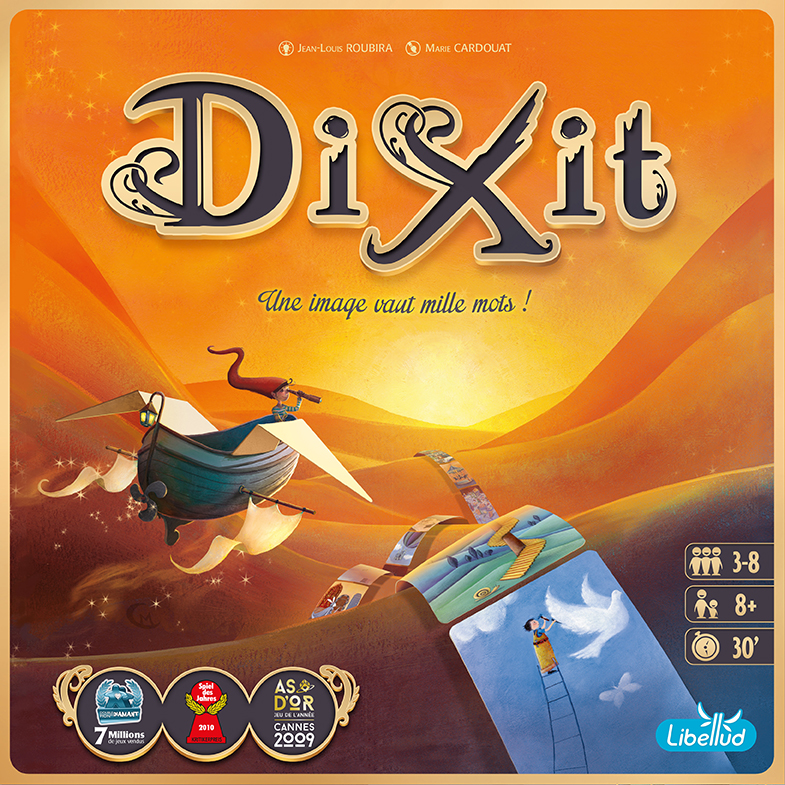
Six years, a dictionary game first played back in student days, four pictures cut out of a children’s magazine and a meeting in Madrid that didn’t go to plan: this is how Dixit was born, the game that asks players to say what they see without ever saying it all. The story of an adventure told by its designer, Jean-Louis Roubira, from the very first prototype to the birth of Libellud.
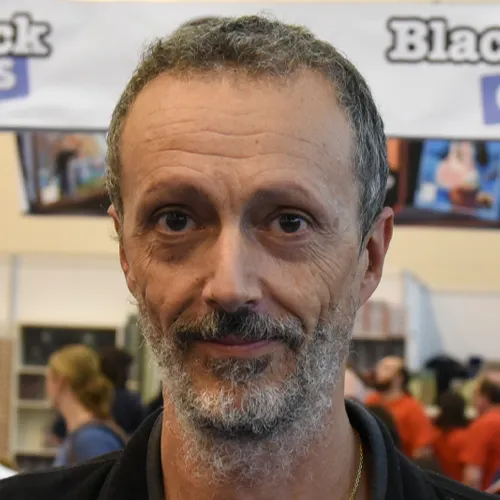

✦ Through the looking glass, today’s designer Jean-Louis Roubira tells us the story of Dixit… ✦
The spark
One morning in November 2002. Ideas often come when you’re just waking up; this time, it felt as though something had been growing inside me for fifteen years or so, quietly, slowly, slowly. A memory came back to me: the dictionary game, which I played so many times back when I was a student.
📖 The dictionary game
Never heard of it? It’s simple: one player opens a dictionary and looks for a rare or tricky word. Each of the other players then writes a definition that sounds believable, while the player who picked the word writes down the real one. Everything gets shuffled together and you have to find the right one.
I remember the thrill of it, the poetry, the invention, being able to play with the music of the language or with the way a single word can carry several meanings. That’s exactly the goal I set myself: to bring back those feelings by letting the players be creators themselves, and put a little piece of their personality into every game, which, I hoped, would create new memories between them.
You know, it’s like those films with imaginative worlds: take The Imaginarium of Doctor Parnassus, or the worlds of Miyazaki and Tim Burton. Each of these films leaves the audience room to dream and imagine a little more than what’s on screen. You can get the same feeling from books, like Alice in Wonderland, or from art, painting, poetry or surrealism. These are worlds I’m particularly fond of.
Before Dixit: Jericho
I should say that it wasn’t the first game I had designed: there had been several, and one of them had been published, briefly. It was called Jericho.
An abstract strategy game for two players, whose prototype dates back to 1999. It won several awards, such as the bronze Ludexpo, the Pion d’or in Boulogne-Billancourt in 2000 and an As d’Or in Cannes in 2001 in the strategy game category. Unfortunately, the game only lived for a few months because the publisher went bankrupt, and that was really frustrating for me.
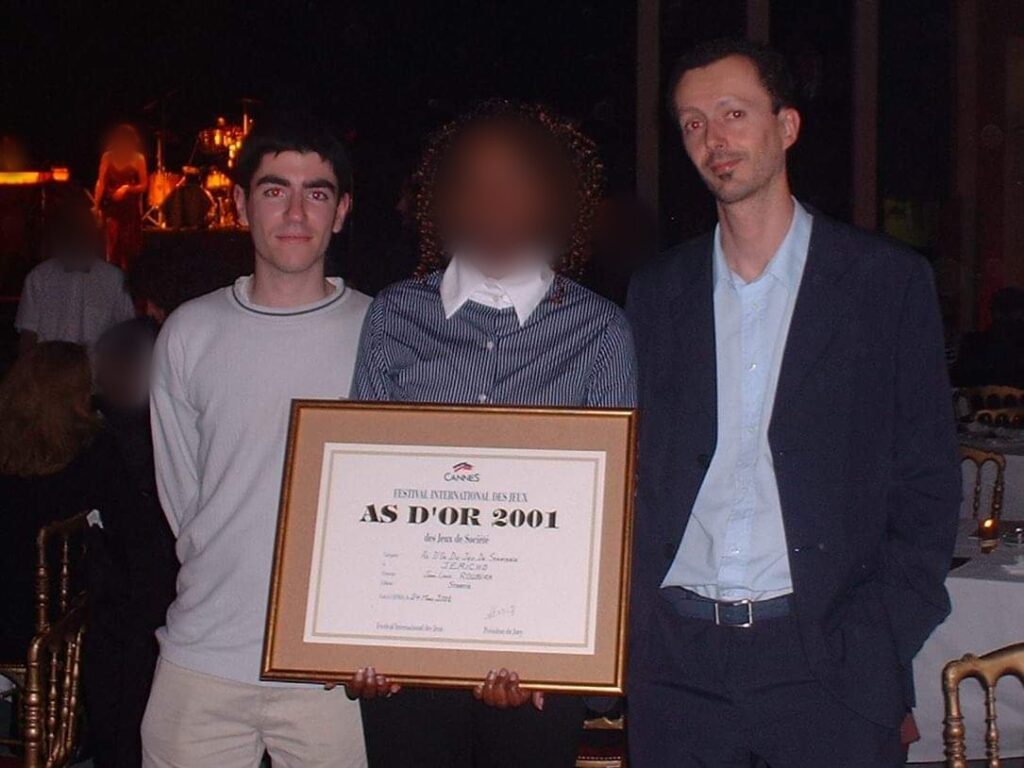
Cannes, 2001: the As d’Or in the strategy game category for Jericho.
But with me, frustration also comes with a challenge, and back then it made me want to do something new. It’s 2002, and I’m about to wake up with an idea in my head…
The birth of Dixit
From the very first prototype, cards were already at the heart of the game. We also had a score board, but that was secondary.
As for the cards, there’s definitely a story to tell. It all started with a magazine my children subscribed to; to find its title, here’s the card I’m going to show you:

Can you guess the name of the magazine?
In that magazine, there were 4 pictures to cut out, by the Spanish illustrator Ulises Wensell. They were inspired by poems by Jacques Prévert and matched exactly the dreamlike, poetic world I was looking for. Now, if you think that was easy, think again: I had to drive a hard bargain with my children to get the cards back and make my prototype, and I think it would have been easier to negotiate with Yubaba in Spirited Away.
In the end, once they had started playing the prototype, they never asked for the cards back. So I had several dozen cards to test my prototype, and that was enough.
In that first version, the score track and the voting tokens were bits of cardboard, and I had pawns to move along the track. I couldn’t tell you how many prototypes there were, because development went on for several years; what I can tell you is that I kept Ulises Wensell’s cards the whole time. The changes were mostly about scoring, for example the storyteller scoring as many points as there were voters. What never changed, right from the start, is that the storyteller scores nothing if everyone finds their card, or if nobody does. I’d say we had 95 % of the game with the first prototype.
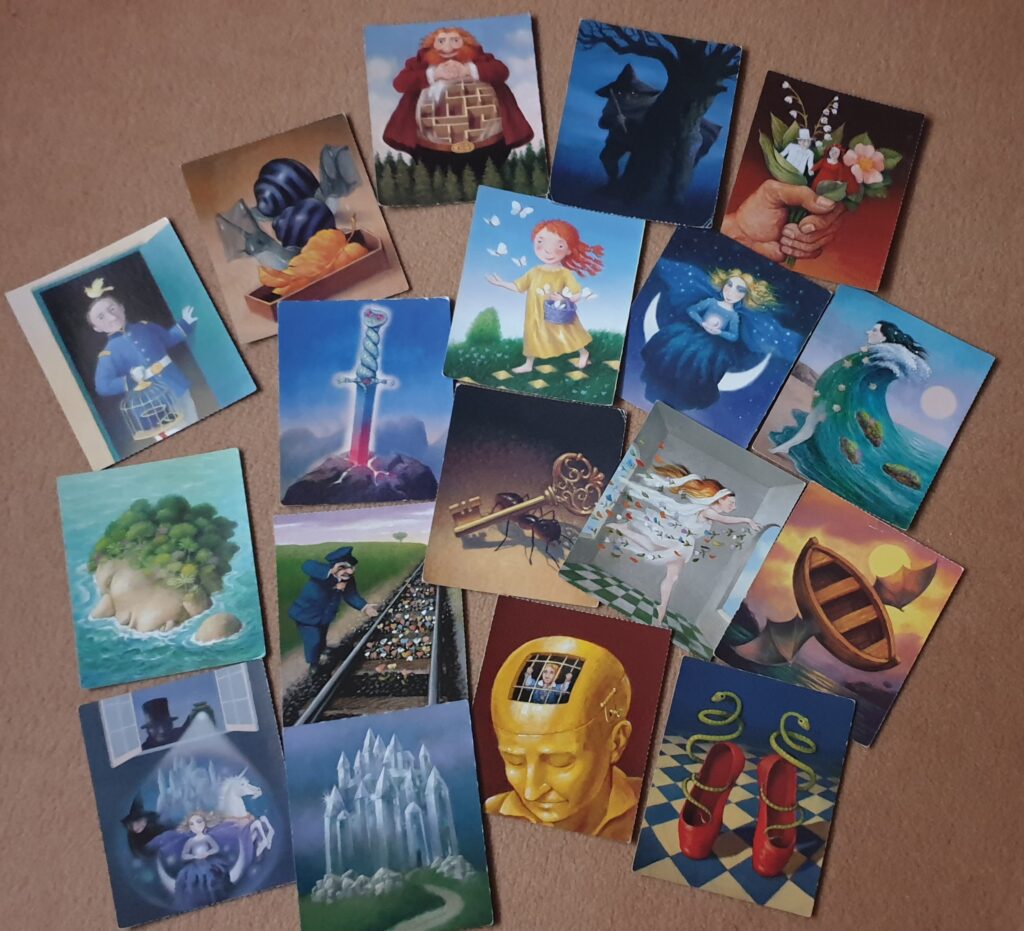
Ulises Wensell’s cards, the ones from the very first prototype.
Games are better with others
Although I designed the game on my own, Régis Bonnessée saw its potential very quickly. I had met Régis at FLIP 2000, in the designers’ area: I was showing Jericho, still a prototype at the time, and he was showing another game. Since he lived in Poitiers, we were able to keep meeting up, talking and playing, and he even designed the Jericho box, as a graphic designer. When I came up with Dixit, he was naturally one of the first testers and stayed with me throughout the whole adventure, right up to the creation of Libellud. Régis made his mark on the game world in 2005 with Himalaya, a Spiel des Jahres finalist, and without him, Dixit would certainly not have become what it is today.
Of course, family and friends played a very important part: we played a huge number of test games, and they were enthusiastic, sometimes to the point of playing again and again without noticing the afternoon go by. Even the “non-gamers” in the family got hooked and kept asking for more, so that was a sign the game had real potential.
And then there are the first-time players, the ones discovering the game. Whether it was the very first player or anyone over those six years, we saw the same reaction. First, you explain the rules, which really are simple: players get the mechanics quickly, but something isn’t quite there yet… Then the game starts, and it’s precisely at that moment, when they have to come up with a clue that’s neither too easy nor too hard, that I see that little spark in their eyes every time, the one that shows they’ve understood what the game is really about.
🧠 Fun Fact
I remember a player once suddenly standing up and announcing: “No! I don’t want to play a Rorschach test!” 😄
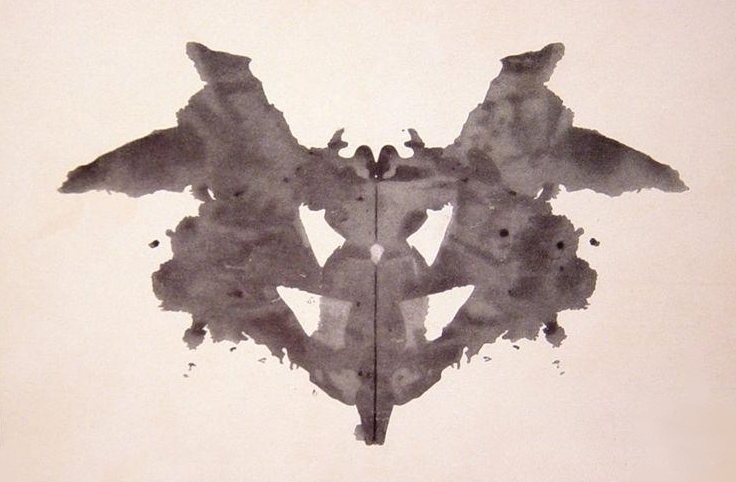
Card I of the Rorschach test.
Rejections, then a thousand boxes
Finding a publisher was quite hard and we got a lot of rejections: we would present the game and get positive feedback afterwards, but in the end the game seemed too intellectual, too different from what was out there, so too risky, and so on. Back then, it really was very different, and I understand the publishers’ reaction: that’s part of the game. Once, we had a meeting with a publisher at a show in Paris, before PEL (Paris Est Ludique); after one minute, the person stopped playing and told us:
“This is the game I’ve always been looking for”
He took the game under his arm and had his teams test it. Régis and I were speechless, but in the end that person didn’t have the final say: our game wasn’t picked…
After those rejections, I had the chance to use the game during a clinical research project in 2005, in an educational centre, with teenagers who had turned their backs on school and had behavioural problems. At the end of the study, a year later, the bodies funding the association pre-ordered 1,000 boxes of the game to hand out to educational centres and foster families in Poitou-Charentes. For Régis and me, it was a sign that we had to go into publishing ourselves.
We wrote a lot of applications to get good loans, such as “Envie d’Agir”, and also support for setting up a business. Dixit was presented as a game for the general public, but also for education and health professionals. It’s that professional side that got us selected by Étincel, a regional organisation that supports founders of innovative companies and helps with everything to do with running a business (business plan, accounting, marketing, legal…). It was a year-long training programme, and it led us to create Libellud. As for me, being a hospital doctor and child psychiatrist, I wasn’t allowed to do both, and I simply didn’t have enough time; I just wanted to remain the designer. So Régis joined the company on his own, in 2007.
Two years to find an illustrator
Now let’s go back in time a little. As I said, we had cards and they worked well. Our first idea was to keep this illustrator’s cards. So we had to get in touch with him. The problem: I knew he lived in Madrid, but walking around Madrid holding up a sign with his name on it didn’t strike me as the easiest solution…
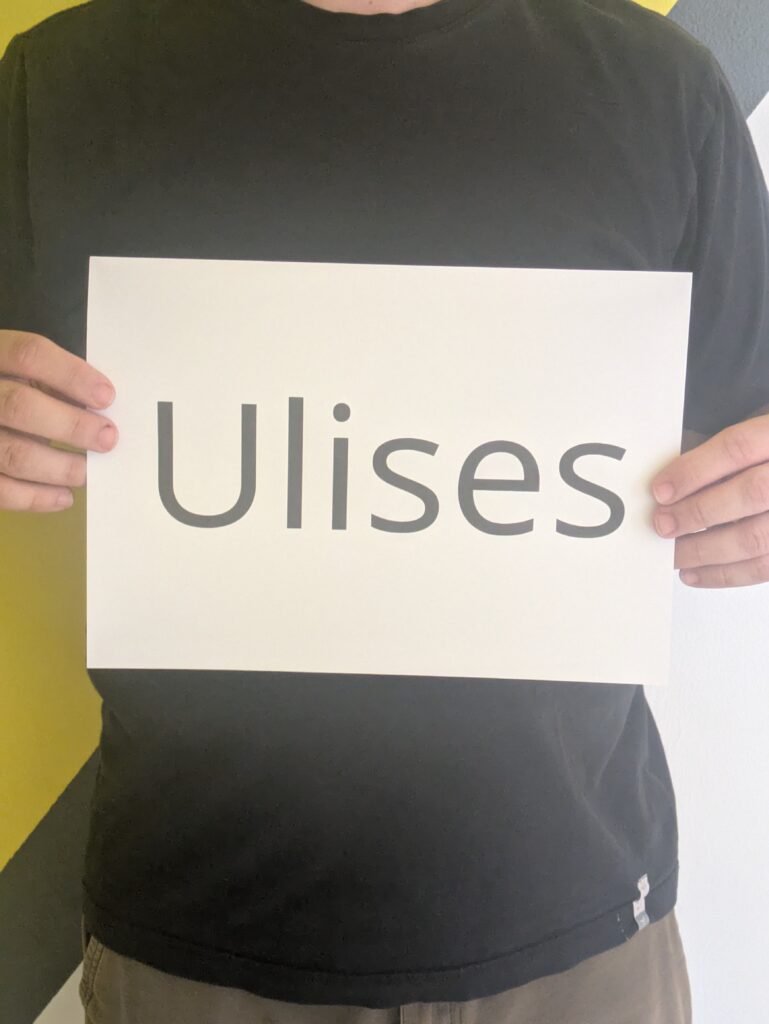
The plan we didn’t go with.
It took me two years to find his contact details and, once I had them… I don’t speak Spanish 😢, so a friend translated the letter I sent him asking to meet. A year later, the meeting was finally set, and there we were in November 2006, heading to a little café opposite the Royal Palace in Madrid, excited about what promised to be a great meeting. He was late, I was getting anxious and thinking he might not turn up… Finally he arrived, we had a magical time around the game and ended the meeting with an agreement to use his illustrations, in exchange for royalties of course. At that moment, I was very happy.
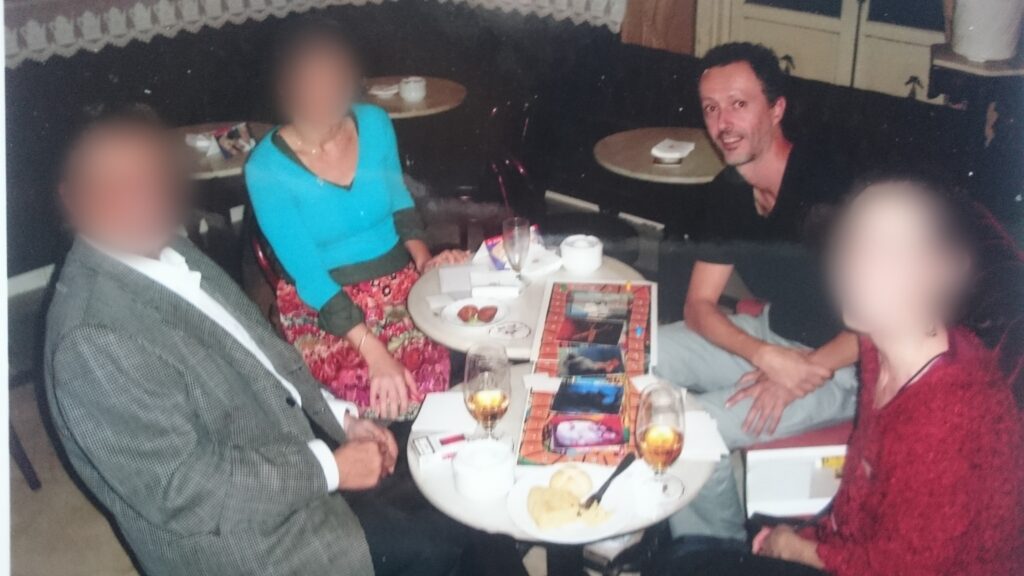
Madrid, November 2006: meeting Ulises Wensell at last.
All that was left was to contact the magazine’s editor-in-chief. And that’s when disappointment set in, because she wouldn’t give us her consent! Everything fell apart and I was ready to give it all up… But that’s also when having a team and people around you really counts. Régis, who hadn’t necessarily tied the game to those particular cards, picked me back up and suggested something else…
Régis put out a call for projects on illustrators’ websites. We went through the applications and the artists’ portfolios, and one of them was chosen: Marie Cardouat. Her style was poetic, slightly childlike and dreamlike, and that’s what we were looking for.
In Libellud’s early years, we didn’t have an art director, so Régis and I tried to come up with ideas for the cards. Sometimes an illustrator gave us ideas, but mostly it was Régis and me.
We did have a direction though: we wanted the pictures to have several meanings, so that everyone could project something personal into them and stir up memories and emotions through their own references. It was also inspired by pop culture, myths, fairy tales, literature, painting and cinema.
The first version, for example, was simple: the cards contained symbolic, universal elements, arranged so as to create cognitive dissonance, as if they were a fragment of a dream. The hard part was finding elements that let you make associations and interpret them, while keeping things shared, with overlaps between the cards. A clue could match several different cards, so we needed similar themes or symbols that could belong to the same field of words or symbols.
In the end, we went off in all directions for the first twenty cards. The target was 84, a number that let us create enough links between them. After those 20 cards, we switched to writing a description of each illustration we wanted, deliberately keeping it vague so the artist had room to create. Marie Cardouat, and other artists later on, also suggested card ideas that we kept. All in all, it took more than six months of work to make the cards.
The box and the name
For the box, we decided to make the box itself a “part of the game”: we wanted you to be plunged straight into the poetic world of the game the moment you opened it. Symbolically, you go through the looking glass and, when you open it, the white rabbit takes you down the hole to discover the components and the beautiful cards. Around the hole you can see the score board, with stones and flowers for the rabbits to hop around on. It’s a nod to Alice in Wonderland, of course, even though the very first version had water lilies. We’re genuinely very proud of the result.
As for the name, it was originally “Quiproquo” (a mix-up): I felt it fitted well with misunderstandings, things left unsaid and words with several meanings. However, Cocktail had just released “Kiproko”, even though it’s very different from Dixit, and above all Régis felt it had a slightly negative ring to it…
I then suggested “Imago”: I had used the word in my work as a child psychiatrist and, beyond images, it also refers to parental imagos, a psychological reference that makes sense. But this time the game was meant for the general public, and “Imago” is still rather specialised.
So we brainstormed and, after dozens and dozens of words on lists and several months… “Dixit” came up, and for Régis and me it said a lot: “he said”, in Latin. It’s striking and fairly universal.
The first box, and what came next
In the end, 6 years went by between the idea in 2002 and the release in November 2008, with plenty of adventures along the way, as you’ve read. One day, we went to a farm, the one belonging to Yves Renou, who ran “Paille Éditions”, the game’s distributor. He was almost a neighbour, on a regional scale: we lived in Poitiers, him in Limoges. That day, he handed us a box, the first box of Dixit, and behind him, boxes and boxes of the game: it was pure wonder, with all the emotion you can imagine.
🏆 What Dixit became
As d’Or – Game of the Year in 2009, Spiel des Jahres in 2010, then a dozen or so international awards. Since then, the range has kept on growing: eleven numbered expansions, drawing on many illustrators, standalone games (Odyssey, Journey), a Disney edition, a version for children, a digital adaptation, and even a print run reserved for the Cannes Film Festival. All of it translated into some thirty languages.
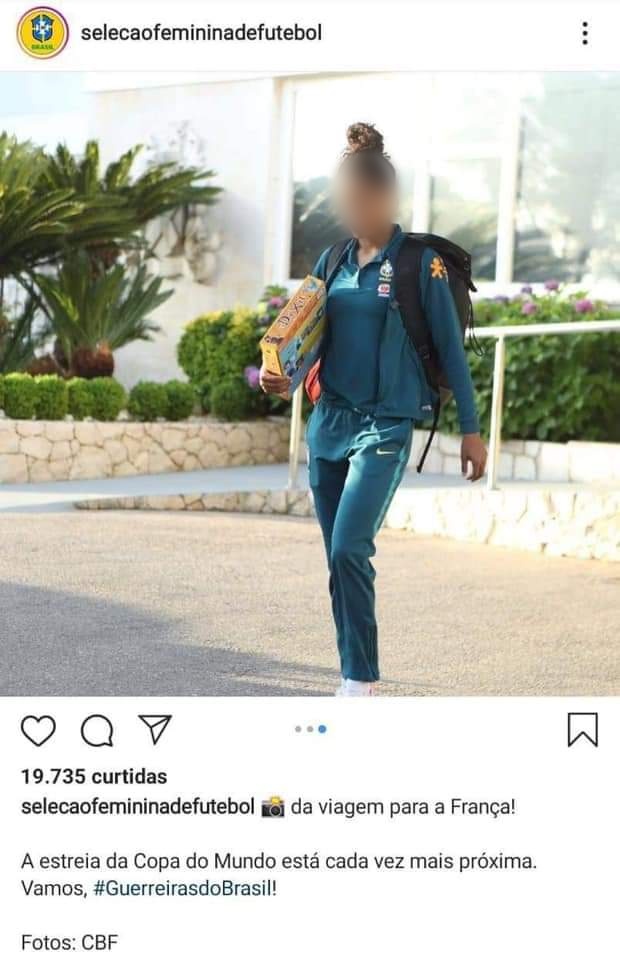
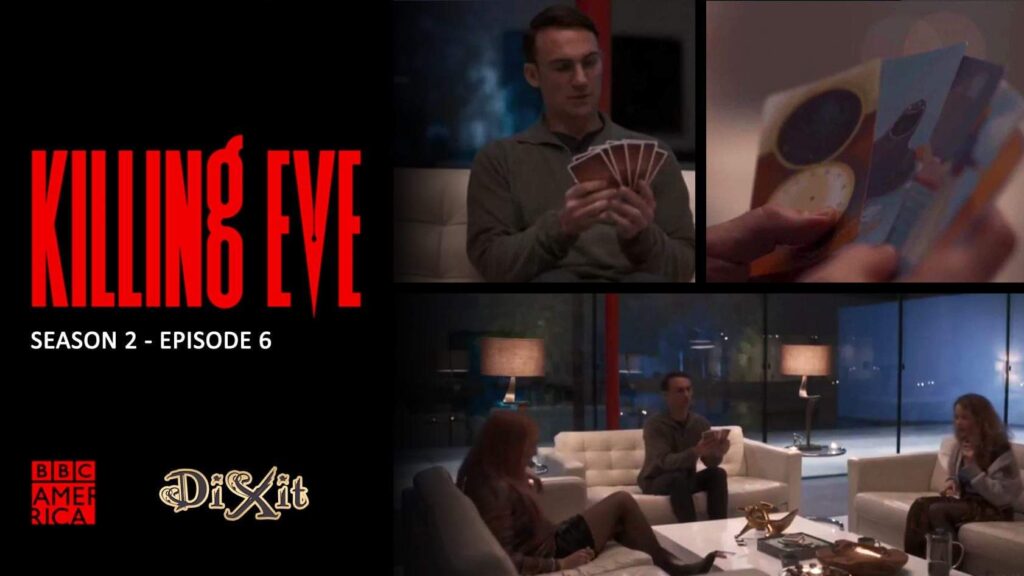
Dixit under the arm of a Brazilian player on her way to the World Cup in France, and on the table in the series Killing Eve (season 2, episode 6).
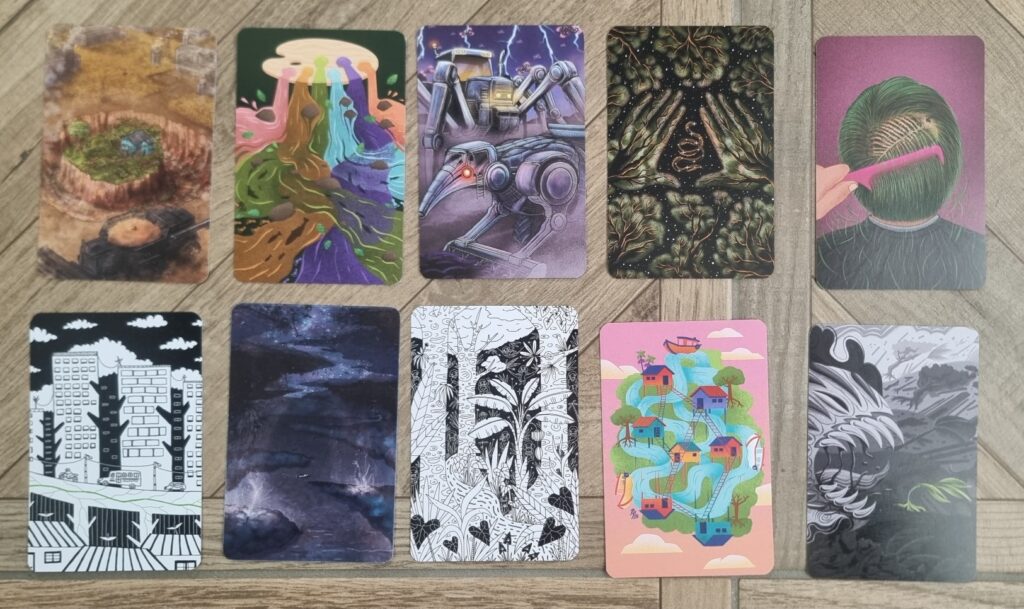
Dixit Amazônias, a special edition illustrated by artists from the Amazon and handed out to schools in the region.
Today, when I see strangers playing my game, it still moves me: I go closer, I watch, I listen and I try to guess whether they’re discovering the game for the first time and whether they have that little spark in their eyes. Of course I’d love to sit down at the table and play with them, but I walk away, quietly, and leave them to their adventure and their memories.
I wouldn’t change a single thing about this story: Régis, at the helm, has done things perfectly. What needed to be done was done well, so that the game would be known, beautiful, and well published.
As for me, I’m looking ahead: I’ve had the chance to make prototypes over the last 5 years and I count more than 50 of them. Very few get published; the market has been saturated for a few years now, marketing plays an ever bigger part and it’s harder to find a distributor. That’s what pushed me, last year, to set up my own company, Daïmon Play, and I have my first self-published game, Good Fortune, distributed by Néoludis. The second one, Domiko, comes out at the end of this year, and I’m working on 6 prototypes, due out over the next few years.
Of course, Dixit is never far away and… that’s all I’ll say 😉
What I take away from it
My conclusion is about two things. The first is to tell anyone who wants to design games to start by asking themselves these questions:
- What do you want players to feel when they play your game?
- What do you want to spark in them?
- Do you want to get them thinking strategically?
- Do you want them to feel strong emotions?
Today, these are the first questions I ask myself when I start on a new concept. For my part, what I’m looking for above all is for the player to have a unique experience and, after the game, to remember the highlights they lived through during it.
Lastly, there’s one comment I’ll keep. Many comments touch me, people telling me the game has done something for them, within themselves, in their family, sometimes even at work. But I’ll finish with the words of a member of the Cannes jury, when the As d’Or – Game of the Year 2009 was presented:
“Dixit isn’t just a board game, it’s a game that brings people together”
That sums up the hundreds of stories people have shared with me at game shows!
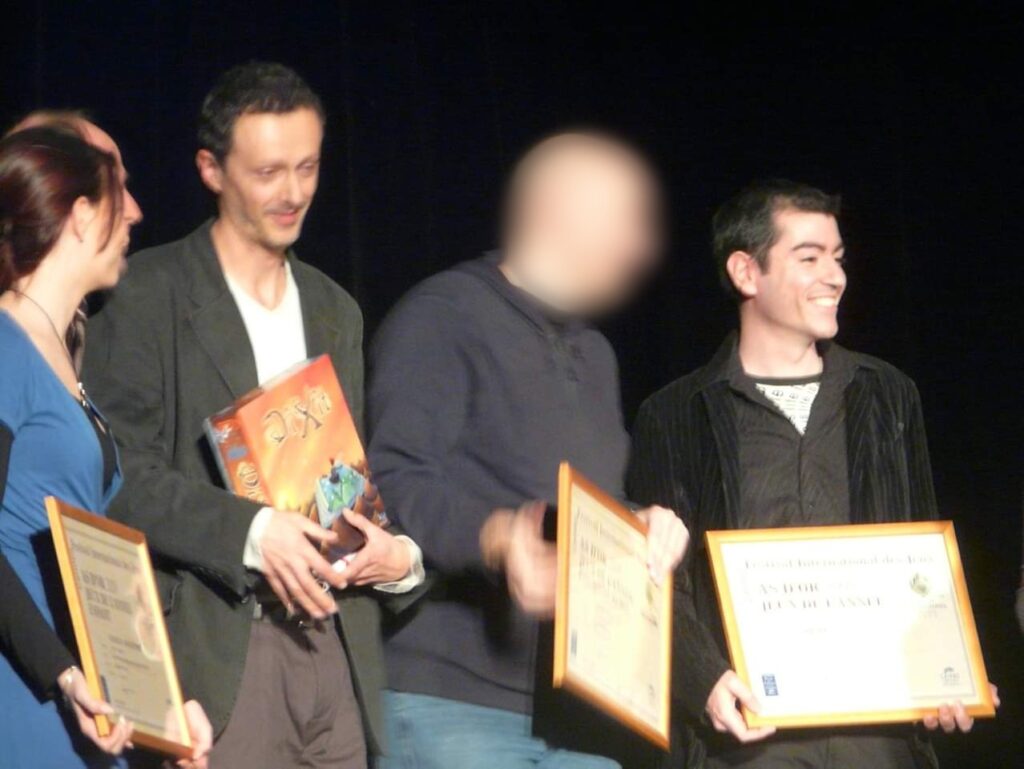
Cannes, 2009: Dixit receives the As d’Or – Game of the Year.
🐇 If my game were a person…
She’d have style, she’s simple, dreamy, open, very sociable. She has a lot of imagination. I’d love to meet her… (It’s not me! 😉)